

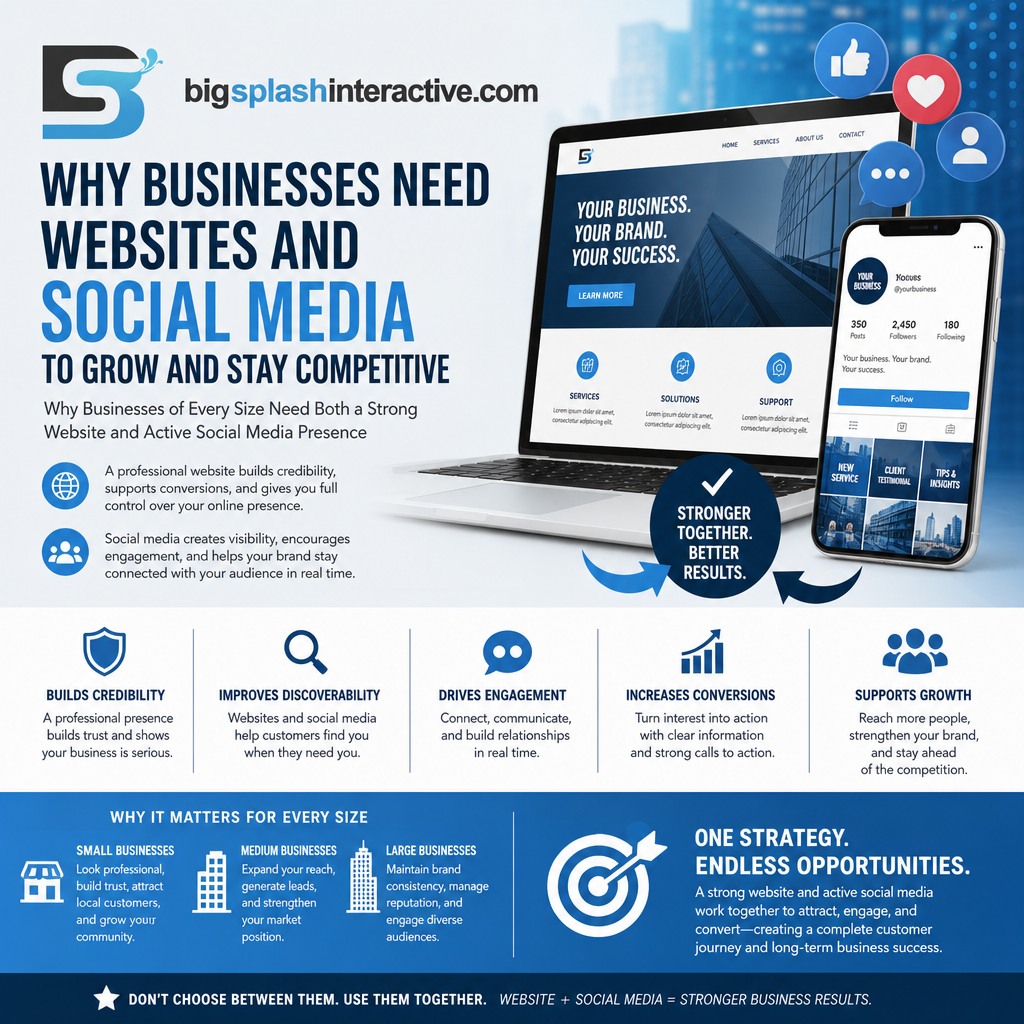
In today’s digital marketplace, businesses can no longer afford to choose between a website and social media. Whether a company is small, medium, or large, long-term success depends on maintaining both. A professional website builds credibility, supports conversions, and gives a business full control over its online presence. Social media, on the other hand, creates visibility, encourages engagement, and helps brands stay connected with their audience in real time.
Companies that rely on only one of these channels often limit their growth. A website without social media can be hard to discover, while social media without a website leaves a business dependent on third-party platforms it does not own. The strongest digital strategy combines both, allowing each to support the other and create a more complete customer journey.
Consumers now expect every legitimate business to have a reliable online presence. Before making a purchase, booking a service, or contacting a company, people often search online to learn more. They may look for a website to confirm products, services, pricing, operating hours, testimonials, or contact details. They may also check social media to see how active the business is, how it interacts with customers, and whether its brand feels current and trustworthy.
This behavior applies across industries. A local restaurant, a regional law firm, an online retailer, a construction company, and a multinational brand all face the same core expectation: customers want easy access to accurate information and a clear sense that the business is real, responsive, and relevant. A company that neglects either its website or social media may appear outdated, difficult to reach, or less established than competitors.
Keeping up with both platforms is not about following trends for the sake of appearance. It is about meeting customer expectations, protecting brand reputation, and creating multiple opportunities for discovery and conversion.
Some businesses make the mistake of assuming that social media alone is enough. While social platforms are useful for visibility and interaction, they are not a replacement for a well-maintained website. A website remains the foundation of a business’s digital presence because it provides ownership, structure, and control.
A professional website gives potential customers confidence. It shows that the business has invested in its brand and is serious about serving its audience. Visitors expect to find clear information about what the company does, who it serves, and how to get in touch. Without that, many people may hesitate to move forward.
Social media platforms are rented space. Their algorithms, policies, and features can change at any time. A website is owned space, meaning the business controls the messaging, layout, content, and customer experience. This control is essential for brand consistency, lead generation, and long-term marketing stability.
Search engines remain one of the most important ways customers find businesses. An updated website with relevant content, optimized pages, accurate business information, and a strong user experience can help improve visibility in search results. This makes it easier for people to discover a company when they are actively looking for products or services.
A website can be built around clear business goals. It can guide visitors to request a quote, schedule a consultation, make a purchase, sign up for a newsletter, or contact the business directly. Social media often sparks interest, but the website is usually where serious decisions happen.
If a website is the foundation, social media is the engine that keeps a brand visible and engaged with its audience. Social platforms allow businesses to communicate more frequently, showcase personality, and stay present in the daily lives of potential customers.
People spend a significant amount of time on social media. Maintaining an active presence helps businesses stay top of mind and reach audiences where they already are. Regular posting can introduce a brand to new followers and reinforce familiarity with existing ones.
Unlike a website, social media creates opportunities for two-way conversation. Customers can comment, send messages, ask questions, and share content. This interaction helps businesses build trust, respond quickly, and demonstrate attentiveness.
A website often serves a more structured and informational purpose, while social media allows a business to show its voice, values, team, and culture. This helps brands feel more approachable and relatable, which can be especially important in competitive markets.
Social platforms are ideal for sharing announcements, promotions, updates, educational posts, behind-the-scenes content, and industry insights. They can drive traffic back to the website, where users can take the next step.
It is easy to see why some companies lean heavily toward one platform. A business might believe its website is enough because it looks polished, or it may depend almost entirely on social media because posting feels quicker and more accessible. However, this approach creates gaps in visibility, credibility, and conversion.
A website and social media serve different but complementary roles. One is not a replacement for the other. A website acts as the central hub for information and business objectives. Social media acts as an outreach and relationship-building tool. When these channels work together, they strengthen every stage of the customer journey.
A business may have a strong website, but without social media it can miss opportunities to reach new audiences, stay visible, and engage with people regularly. It may appear less active or less connected to its community.
A business may attract attention on social media, but without a website it lacks a stable, professional destination where visitors can explore services, trust the brand, and complete meaningful actions. This can lead to missed sales and reduced credibility.
The most effective digital strategy is one in which the website and social media support each other. Social media can create initial awareness, spark interest, and encourage users to learn more. The website can then provide the depth, structure, and calls to action needed to convert that interest into inquiries, sales, or long-term relationships.
For example, a business might publish a social media post highlighting a new service, customer success story, or seasonal promotion. Interested users click through to the website, where they find detailed information, pricing, testimonials, and a contact form. In this way, social media becomes the doorway and the website becomes the destination.
The relationship also works in reverse. Website content such as blog posts, case studies, product pages, service updates, and company news can be repurposed into social media content. This makes it easier to maintain consistent messaging and extract more value from every piece of content created.
Small businesses often work with limited budgets and time, which can make digital marketing feel overwhelming. However, maintaining both a website and social media presence is especially important for smaller companies because they need to establish trust quickly and compete with larger, more visible brands.
A website helps a small business look professional and legitimate, even if the company is new or locally focused. It gives customers a place to learn about services, read reviews, see business hours, and take action. Social media helps the business stay visible in the local community, build relationships, and show personality in ways that larger companies may struggle to match.
For a small business, both channels can have a direct impact on growth. A potential customer might discover the brand through a social media post, check the website to confirm details, and then decide to call or visit. If either touchpoint is missing or outdated, that opportunity can be lost.
Medium-sized businesses are often in a critical stage of expansion. They may have an established customer base and a growing reputation, but they still need to strengthen market position and scale efficiently. For these businesses, a website and social media presence are essential tools for consistency, lead generation, and brand development.
An updated website allows a medium-sized business to present a broader range of services, target multiple audience segments, and support more advanced marketing efforts. Social media helps maintain momentum by promoting content, showcasing expertise, and supporting customer engagement at scale.
Businesses in this category often face more competition than when they were smaller, and customers have higher expectations. Keeping both channels active ensures the brand looks current, organized, and capable of meeting those expectations.
Large businesses may already have brand recognition, but that does not remove the need to maintain both a website and social media. In fact, the larger the company, the more important it is to keep digital channels aligned, updated, and responsive. Customers expect large organizations to deliver polished experiences and timely communication across every platform.
A large business’s website often supports multiple products, services, regions, or departments. It acts as a key operational and marketing asset. At the same time, social media allows large brands to stay relevant, manage public perception, address concerns quickly, and communicate with diverse audiences.
For enterprise-level companies, neglecting either channel can lead to reputational damage, reduced customer confidence, and missed engagement opportunities. A large brand that appears inactive online may be seen as disconnected, while one that relies too heavily on social media without a strong website may appear disorganized.
Digital neglect can have serious consequences. An outdated website with broken pages, old information, or a poor mobile experience can discourage potential customers before any conversation begins. Likewise, inactive or inconsistent social media profiles can make a business seem disengaged or unreliable.
Falling behind does not just affect appearance. It can reduce discoverability, weaken customer trust, and create an advantage for competitors who are more current and responsive. Businesses that fail to keep up may also miss important shifts in customer behavior, platform trends, and online expectations.
Many businesses delay improving their digital presence because they think everything must be perfect before they act. In reality, consistency matters more. A clean, accurate website and a steady, thoughtful social media presence can deliver strong results over time. The goal is not to publish constantly or redesign everything at once. The goal is to remain active, useful, and aligned with customer needs.
This means updating business information, refreshing key pages, sharing relevant posts, responding to messages, and maintaining brand consistency across platforms. Small improvements made regularly can be far more effective than occasional bursts of activity followed by long periods of silence.
Staying current does not have to be complicated. Businesses of all sizes can maintain both channels by focusing on practical, repeatable habits.
When a business invests in both its website and social media, it creates a stronger and more resilient digital presence. Customers can find the brand through multiple channels, verify its credibility, engage with its content, and take action when they are ready. This creates a more complete experience and supports both short-term marketing efforts and long-term brand growth.
Businesses that keep both channels active are often better positioned to adapt to changes in the market. They can launch promotions more effectively, share updates quickly, gather audience feedback, and improve their messaging based on real interactions. This agility is valuable for businesses of every size.
For small, medium, and large businesses alike, keeping up with both a website and social media is no longer optional. Each plays a distinct role in how customers discover, evaluate, and connect with a brand. A website provides credibility, ownership, and conversion opportunities. Social media provides visibility, engagement, and ongoing relevance.
Businesses that focus on only one are leaving opportunities behind. Those that maintain both create a more trustworthy, accessible, and effective digital presence. In a competitive environment where customers expect convenience and consistency, the combination of a strong website and active social media can make a meaningful difference in brand perception, customer relationships, and overall business growth.
The strongest online strategy is not website versus social media. It is website and social media working together to support the full customer journey.