

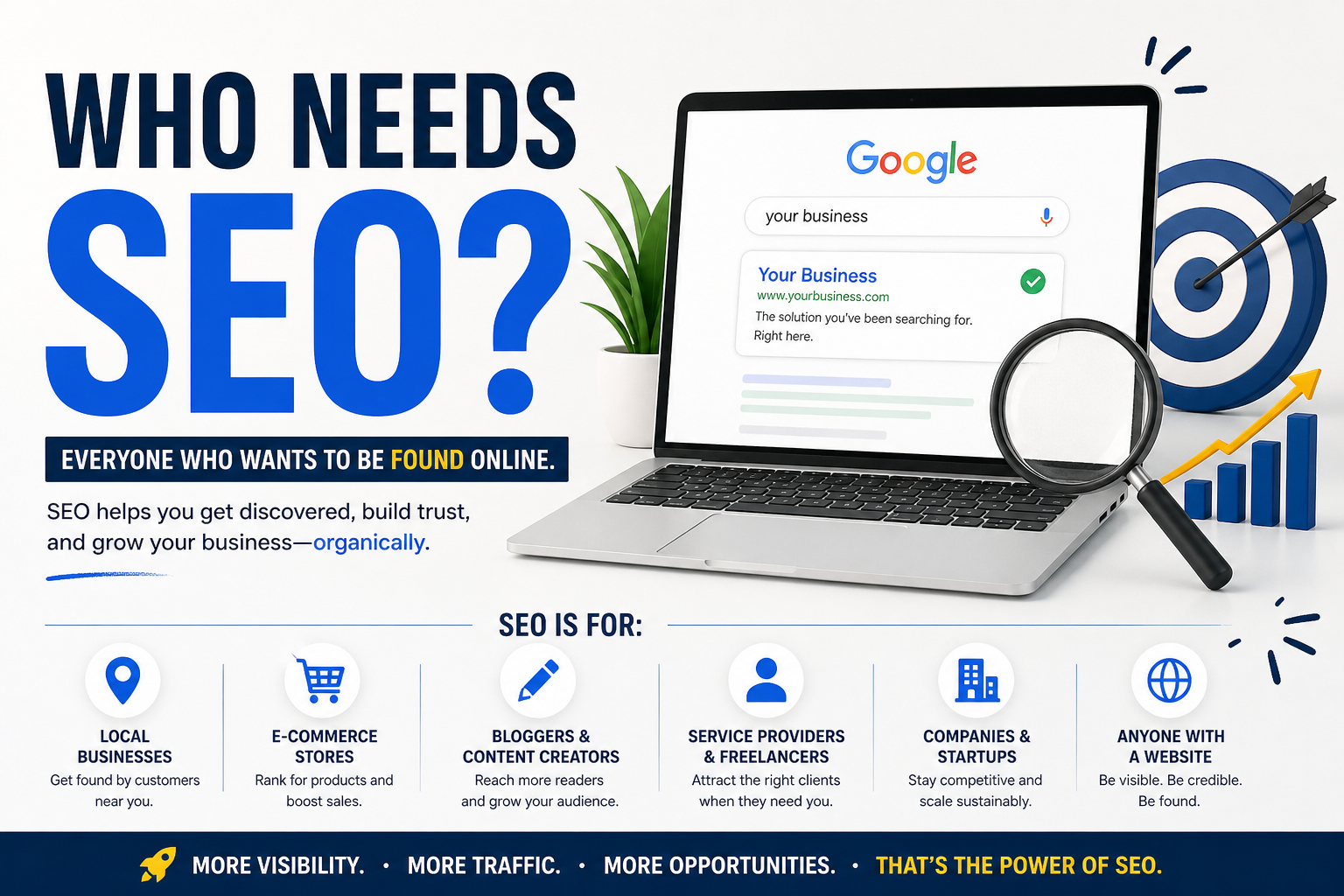
Search Engine Optimization (SEO) often gets treated like a “marketing extra”—something only big companies or tech-savvy brands worry about. In reality, SEO is useful for almost anyone who wants to be found online.
If people are searching for what you offer, SEO determines whether they find you… or your competitors.
Below is a breakdown of who actually needs SEO—and why it matters for each.
If you run a local business—like a café, contractor service, salon, gym, or repair shop—SEO is one of the most powerful tools you have.
Most customers don’t browse endlessly anymore. They search:
“plumber near me”
“best coffee shop in town”
“car repair open now”
Without SEO, your business may not show up in those results at all.
Local SEO helps you:
Appear in Google Maps results
Show up for “near me” searches
Compete with larger companies nearby
If you sell products online, SEO is critical. Paid ads can bring traffic—but they stop working the moment you stop paying.
SEO helps e-commerce stores:
Rank for product searches (“wireless earbuds under $50”)
Attract free, ongoing traffic
Reduce dependency on ads
Increase trust through organic visibility
Even small stores can compete with big brands if their SEO is strong and focused.
If you create content—blogs, YouTube support pages, newsletters, or niche websites—SEO is how new people discover you.
Instead of relying only on social media algorithms, SEO allows your content to be found through search.
Benefits include:
Steady long-term traffic
Audience growth without constant posting
More authority in your niche
A single well-optimized article can bring traffic for years.
If you sell a skill—like design, writing, coaching, consulting, or development—SEO helps people find you when they need you most.
For example:
“freelance logo designer”
“business coach for startups”
“web developer for small business”
SEO connects you with people who already want your service, making leads warmer and easier to convert.
Even large businesses need SEO. In fact, the more competitive the industry, the more important SEO becomes.
SEO helps established companies:
Maintain visibility against competitors
Protect brand searches
Capture high-intent customers
Reduce advertising costs over time
Without SEO, even big brands can slowly lose search visibility.
Startups often have limited budgets. SEO offers a long-term growth channel that doesn’t scale with ad spend.
Good SEO helps startups:
Gain traction without massive ad budgets
Build early authority in their industry
Attract investors by showing organic demand
It’s one of the most cost-efficient growth strategies available.
If you have a website and want anyone to find it through search engines, you need SEO in some form.
Even basic SEO ensures:
Your pages are indexed correctly
Your content is understandable to search engines
You’re not invisible online
Without SEO, a website is often like a storefront with no sign.
Very few people truly don’t benefit from SEO. The only exceptions are situations like:
Private/internal websites
Temporary landing pages with no long-term goals
Businesses relying entirely on offline referrals
For everyone else, SEO is either helpful or essential.
SEO isn’t just a marketing tactic—it’s a visibility system.
If people are searching for answers, services, or products in your space, SEO decides whether they find you or someone else.
In most cases, the real question isn’t “Do I need SEO?”
It’s “How much opportunity am I losing without it?”