

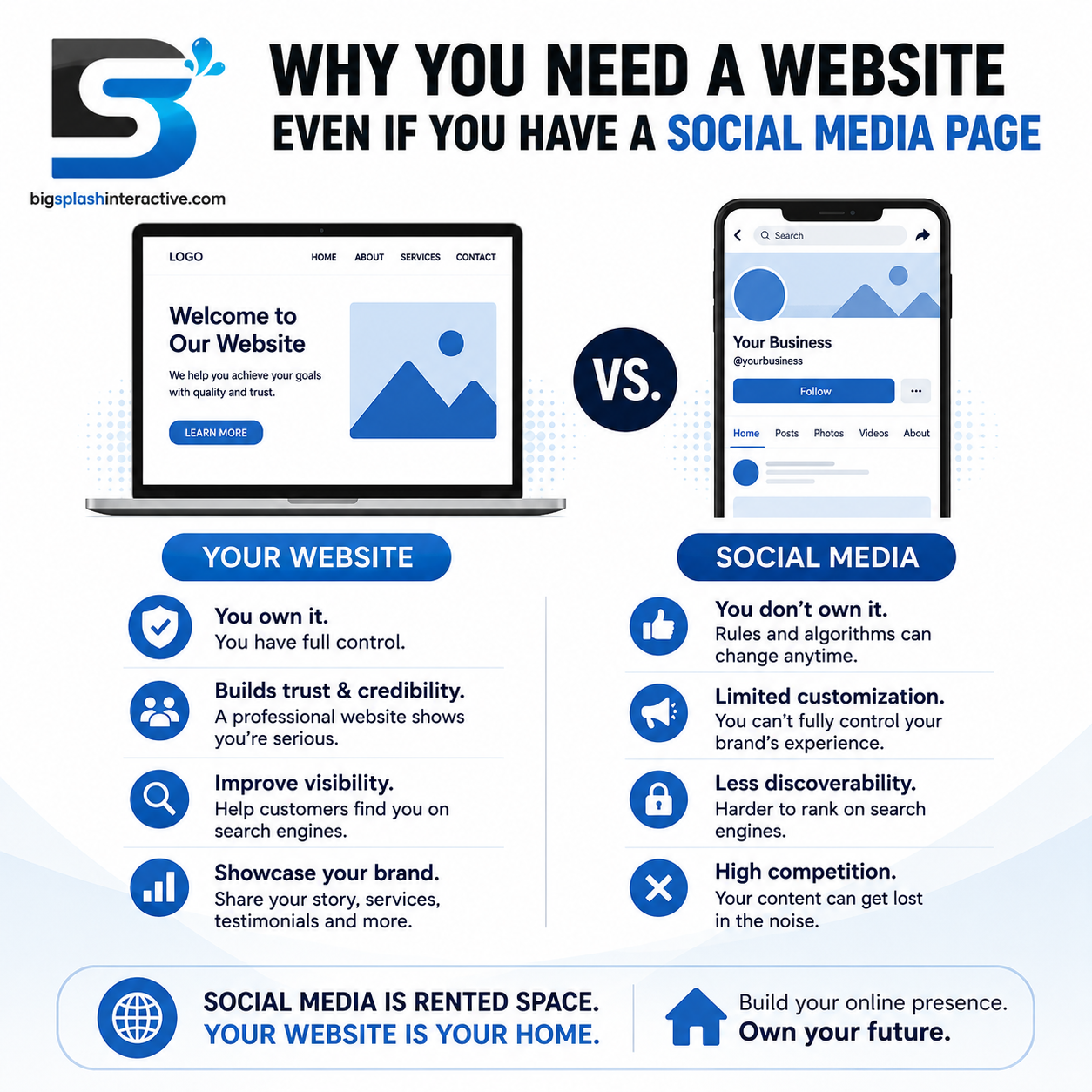
In today's digital world, many business owners wonder if a website is still necessary when platforms like Facebook, Instagram, TikTok, LinkedIn, and X make it easy to connect with customers. Social media is an incredible marketing tool, but relying solely on social media can limit your business growth and leave you vulnerable to factors outside of your control.
The reality is simple: social media should support your online presence, not replace your website.
One of the biggest misconceptions business owners have is treating social media pages as their primary online asset. While you control the content you post, you do not control the platform itself.
Social media companies can:
Change their algorithms at any time
Restrict the visibility of your posts
Suspend or remove accounts
Introduce new fees or advertising requirements
Change platform policies without notice
A website, on the other hand, is digital property that belongs to your business. You control the content, design, messaging, and customer experience.
When potential customers search for your business online, they often expect to find a professional website.
A well-designed website helps establish:
Trust
Professionalism
Authority
Brand consistency
Many consumers view businesses without websites as less established or less trustworthy. Your website serves as your digital storefront and often creates the first impression potential customers have of your company.
When people need a product or service, they usually turn to search engines first.
For example:
"Roofing company near me"
"Best dentist in town"
"Emergency plumber"
"Local marketing agency"
Without a website, your ability to appear in search engine results is extremely limited. Social media profiles rarely provide the same search visibility as a properly optimized website.
A website allows you to:
Target local customers
Rank for valuable keywords
Publish helpful content
Generate organic traffic
Capture leads around the clock
Search engine optimization (SEO) works best when built on a strong website foundation.
Unlike a physical storefront, your website never closes.
Customers can:
Learn about your services
View products
Read reviews
Submit contact forms
Request quotes
Make purchases
Whether it's 2 PM or 2 AM, your website continues working for your business.
Social media can help attract attention, but your website is where customers often go when they're ready to take action.
Social media platforms limit how much you can customize your page.
Every business page follows a similar layout and appearance.
A website gives you complete control over:
Branding
Colors
Design
Navigation
User experience
Calls to action
Your website allows your business personality to shine while creating a unique experience that separates you from competitors.
The primary goal of marketing is generating leads and sales.
A website can be strategically designed to guide visitors through the customer journey with:
Contact forms
Appointment scheduling
Online ordering
Lead capture forms
Product catalogs
Service pages
Instead of hoping a social media follower eventually contacts you, your website can actively encourage visitors to take the next step.
The most successful businesses don't choose between social media and a website—they use both.
A smart digital strategy looks like this:
Builds awareness
Engages followers
Creates community
Shares updates and promotions
Drives traffic
Builds trust
Captures leads
Provides detailed information
Supports SEO
Converts visitors into customers
Think of social media as the highway that brings people to your business, while your website is the destination.
A website provides valuable data that can help improve your marketing efforts.
You can track:
Visitor behavior
Traffic sources
Popular pages
Lead conversions
Customer interests
These insights help you make smarter business decisions and improve your marketing return on investment.
Social media trends come and go.
Remember platforms such as MySpace, Vine, and others that once dominated online conversations? Businesses that relied entirely on those platforms had to rebuild their audience elsewhere.
Your website provides a stable foundation that remains under your control regardless of what happens in the social media landscape.
Social media is an essential marketing tool, but it should never be your business's only online presence. A professional website provides credibility, search visibility, lead generation opportunities, and complete control over your brand.
The most effective digital marketing strategy combines the reach of social media with the power and stability of a well-designed website.
If your business currently relies only on social media, now is the perfect time to invest in a website that works for you 24 hours a day, 365 days a year. Your website isn't just another marketing tool—it's one of the most valuable business assets you can own.