

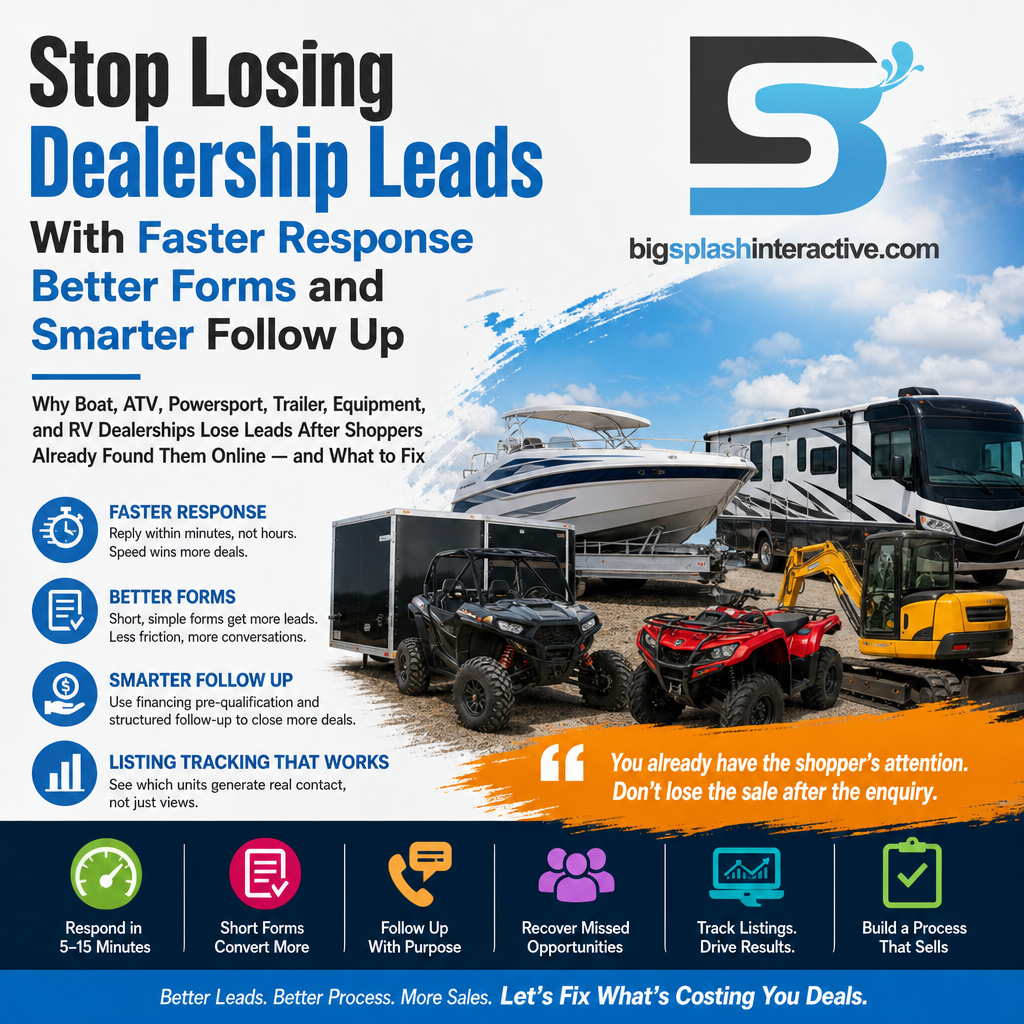
If a shopper has already found your dealership online, searched your inventory, clicked into a listing, and submitted an enquiry, the hard part should be over. Yet for many marine, powersport, trailer, equipment, and RV dealerships, that is exactly where the lead is lost. Not because demand is weak, and not because pricing is always wrong, but because the store fails at speed, form design, follow-up, and tracking.
For a dealership owner or sales manager, this is not a theoretical marketing problem. It is an operational problem that shows up as missed appointments, lower close rates, stale inventory, and salespeople claiming that internet leads are “bad.” In reality, many so-called bad leads were simply mishandled. The shopper was interested enough to raise their hand, but the dealership gave them too much friction, answered too slowly, failed to respond at all, or never measured which listings were actually producing opportunities.
This article focuses on the specific changes a dealership can make to stop losing high-intent buyers who have already found the business online. These recommendations apply across boats, personal watercraft, ATVs, side-by-sides, motorcycles, enclosed trailers, utility trailers, heavy equipment, compact equipment, and RVs. The exact products vary, but the lead-handling mistakes are remarkably similar.
By the time most shoppers submit an inventory enquiry, they are no longer in the broad “just browsing” stage. They have usually done at least some of the following:
That means your response process must match the urgency of the buyer. A lead is not a filing task to be handled whenever someone has time. It is an active buying signal with a short shelf life. In categories like powersports, trailers, boats, and RVs, shoppers often submit multiple enquiries within minutes. They are not waiting half a day for one store to get organized.
The single biggest failure point in dealer lead handling is response time. Many dealerships still operate as if responding “the same day” is acceptable. It is not. If a buyer submits an enquiry on a specific unit, the expectation is increasingly immediate. The first dealership to provide a useful answer often becomes the one that gets the appointment, the credit app, and eventually the sale.
For a dealership owner or manager, the practical benchmark should be this:
| Response Window | What It Means in Practice |
|---|---|
| Within 5 minutes | Best-case standard for high-intent inventory enquiries during business hours |
| Within 15 minutes | Still competitive, but you are already giving other dealers time to reply first |
| Within 30 minutes | Noticeably weaker; many buyers will already have engaged elsewhere |
| Within 1 hour | Often too slow for serious ready-to-buy shoppers |
| Same day | Frequently interpreted by the customer as poor service or lack of interest |
| Next day | In many cases, the lead is effectively gone |
If your team cannot consistently respond to fresh enquiries within 5 to 15 minutes during open hours, you have a process problem. That problem might involve staffing, notification routing, CRM discipline, unclear ownership, poor templates, or all of the above.
Just as important, “response” does not mean an auto-reply that says, “Thanks, someone will contact you shortly.” Buyers do not count that as an answer. A real first response should confirm the unit, address the question if one was asked, and give the customer a next step. For example:
Effective first response example:
“Thanks for your enquiry on the 2024 enclosed trailer. It is currently available. The listed price is current, and I can also confirm the axle setup and interior height for you. If you’d like, I can text you a walkaround video today and hold a time for you to come see it. Are you planning to use cash or financing?”
That is a meaningful response. It answers the real concern behind the lead: Is this unit available, is this dealer engaged, and what happens next?
If internet lead response is inconsistent, the solution is not to lecture the staff once and hope it improves. Build a system. At minimum, dealership management should implement the following:
One of the most common ways dealerships lose leads is by making the enquiry form too demanding. The buyer is interested in a specific unit, but the form acts like a loan application, trade appraisal, and full identity verification process all at once. That creates friction exactly when the customer is deciding whether to contact you or the next dealer.
A strong inventory enquiry form should be short, clear, and optimized for conversion. Its job is not to gather everything your sales process might eventually need. Its job is to start the conversation with the lowest reasonable barrier.
There is a simple reason for this: inventory enquiry forms are for initiating contact, not closing the full transaction. If you ask for too much too early, some buyers abandon the form. Others enter false information just to get through it. Either way, lead quality does not improve. Data quality gets worse.
In many dealerships, long forms are defended with comments like, “We only want serious buyers.” But serious buyers often hate unnecessary friction. They do not want to fill out twelve fields just to ask if the unit is still available, if the listed price is correct, or whether a trailer has brakes on both axles. The form should respect the customer’s stage in the buying process.
Even when fields are limited, some forms still perform badly because of how they are structured. Avoid these common mistakes:
For many dealerships, financing is treated as a back-end step rather than a lead strategy. That is a mistake. Financing pre-qualification can be one of the best tools for identifying and converting serious buyers, especially in RV, marine, powersport, and equipment categories where payment sensitivity is high and monthly budget often determines the deal.
The key is how it is positioned. A basic inventory enquiry form should remain simple. Financing pre-qualification should be offered as a next-step conversion path for motivated shoppers, not forced into the first interaction.
Used properly, financing pre-qualification helps the dealership:
Instead of embedding a heavy finance process inside every lead form, offer it at strategic points:
The language matters. “Apply for financing” can feel heavy and final. “Get pre-qualified” or “See payment options” often feels easier and less intimidating. The point is to lower resistance while still moving the buyer forward.
Example sales follow-up language:
“If you want, I can send you our quick pre-qualification option so you can see realistic payment possibilities on this unit before you come in. That usually helps buyers narrow things down faster.”
That approach feels helpful, not pushy. It also creates a stronger buyer signal. Someone willing to pre-qualify is often much farther down the path than someone who only clicked through photos.
One of the most profitable cleanup opportunities in any dealership is the pile of internet enquiries that were never actually answered. Not delayed. Not worked poorly. Never answered. This happens more than most owners realize, especially when leads come from multiple marketplaces, website forms, trade-in tools, finance tools, and phone tracking systems.
Many of these leads are written off mentally because they are no longer fresh. That is a mistake. While some buyers have already purchased elsewhere, others are still shopping, paused their decision, or remain open to an alternative unit. A disciplined re-engagement process can recover sales that would otherwise stay buried in the CRM.
Simple recovery example:
“I’m following up on your enquiry about the 2023 side-by-side. I wanted to make sure you got the information you needed. If you are still in the market, I can confirm what is available now and send over a few comparable options as well.”
Another major leak in dealership lead performance is poor listing-level tracking. Many stores know their total website traffic and maybe their total lead count, but they cannot answer basic management questions such as:
If you cannot connect listings to contact activity, you are making merchandising and advertising decisions in the dark. This matters because not all inventory pages perform equally, even within the same product category. A boat listing with detailed specs, clear pricing, and strong photos may generate several enquiries, while a nearly identical unit with poor images and vague copy generates none.
| Metric | Why It Matters |
|---|---|
| Listing views | Shows whether the unit is getting visibility at all |
| Form submissions | Measures direct lead generation from the unit page |
| Call clicks or call tracking activity | Captures phone-driven lead behavior |
| Text message initiations | Important for mobile-first shoppers |
| Finance CTA clicks | Indicates deeper buyer intent |
| Photo engagement | Can reveal whether weak merchandising is hurting conversion |
| Price change history | Useful for diagnosing pricing resistance |
| Days on site and days in inventory | Helps compare lead performance against aging units |
Once this is visible, management can take concrete action. If a trailer listing gets views but no contacts, the issue may be price presentation, poor photos, missing specs, weak CTA placement, or an overcomplicated form. If a used RV generates strong lead volume but few appointments, the issue may be slow response or poor lead handling rather than inventory demand.
Lead capture is not only about the form. It also depends on whether the listing gives the shopper enough confidence to reach out. Dealers should review high-traffic inventory pages and improve the following:
If you want a practical improvement plan rather than a general reminder to “work leads better,” start here. These are the changes that most often produce measurable gains:
Make “under 10 minutes during business hours” the target, and monitor it daily. Anything less specific will become optional in practice.
Reduce required fields to the minimum needed to start contact. If your current form feels like paperwork, conversion is being lost before the sales team ever sees the lead.
Keep the initial enquiry simple, then use pre-qualification to identify and move serious buyers deeper into the process.
Do not assume every lead was worked. Verify it. Recover what can still be recovered.
You need to know which actual units produce forms, calls, and finance activity. That is how you improve merchandising and ad spend decisions.
Speed matters, but relevance matters too. A fast generic reply is better than no reply, but a fast, specific, helpful reply wins more often.
Test every step of the lead path on a phone: listing load time, contact visibility, form completion, call button, and financing CTA.
Dealership teams often explain away weak internet performance by blaming lead quality. But in many stores, the real issue is much simpler: the customer already found the dealership, already found a unit of interest, and already tried to make contact. The store then made it hard, slow, or inconsistent to continue.
For boat, ATV, powersport, trailer, equipment, and RV dealerships, the opportunity is not just to generate more leads. It is to stop wasting the ones already coming in. Faster response times, shorter enquiry forms, better use of financing pre-qualification, disciplined recovery of unanswered enquiries, and listing-level contact tracking can produce a meaningful lift without increasing ad spend.
If you are the owner or sales manager, the takeaway is straightforward: tighten the process around the buyer who is already raising their hand. That is where some of the easiest revenue gains are hiding.