

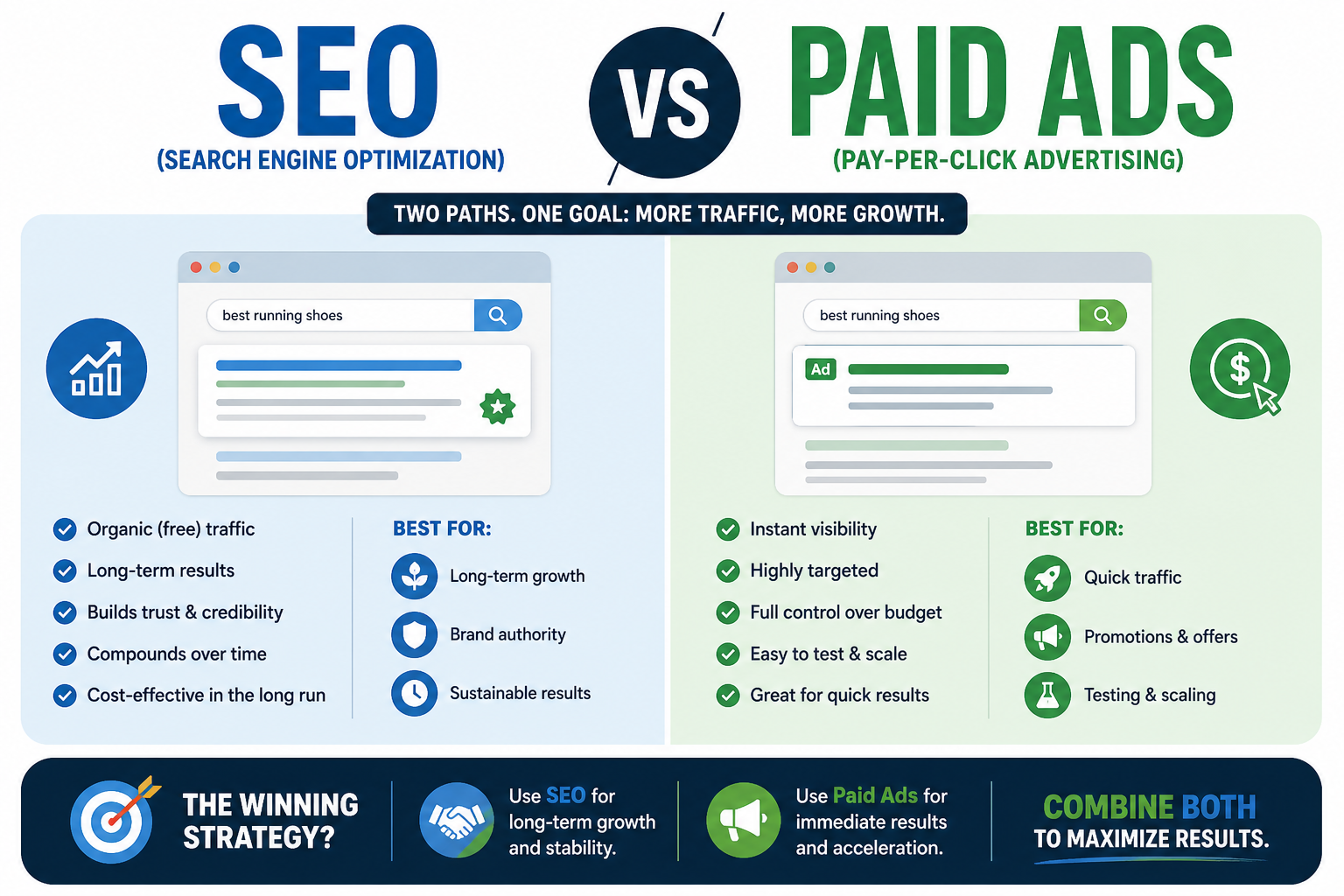
If you’re trying to grow a website, generate leads, or increase sales online, you’ll almost always run into two core strategies: SEO (Search Engine Optimization) and paid advertising (PPC).
At a glance, they seem to do the same thing—drive traffic. But the way they work, the time they take, and the results they produce are very different. Understanding these differences is critical if you want to spend your time and money effectively.
This guide breaks down SEO vs. paid ads in depth so you can decide when to use each—and how to combine them for the best results.
SEO (Search Engine Optimization) is the process of improving your website so it ranks higher in organic search results on platforms like Google.
When someone searches for something like “best gaming laptop” or “plumber near me,” SEO determines which websites appear in those non-paid listings.
Search engines use algorithms to evaluate and rank content based on relevance and quality. SEO focuses on aligning your website with those ranking factors.
There are three main pillars of SEO:
This includes everything on your website:
Keyword optimization
High-quality, useful content
Title tags and meta descriptions
Internal linking
Proper heading structure
This focuses on how your site performs:
Page speed and performance
Mobile-friendliness
Secure connections (HTTPS)
Crawlability and indexing
Fixing broken links and errors
This is about building authority:
Backlinks from other websites
Brand mentions
Online reputation
The stronger your site is across all three areas, the better your chances of ranking higher.
Once your pages rank, they can bring in traffic for months or even years without additional cost per click.
Users tend to trust organic results more than ads, especially for informational searches.
Content builds on itself. The more quality pages you create, the more opportunities you have to rank.
While SEO requires upfront effort, it often becomes cheaper than paid ads in the long run.
SEO is not instant. It can take weeks or months before you see meaningful traffic.
Search engines frequently update their algorithms, which can impact rankings.
In highly competitive industries, ranking can be difficult without significant effort.
Paid ads (commonly referred to as PPC – Pay-Per-Click) allow you to place your website at the top of search results or in users’ feeds instantly.
You pay for visibility, usually based on clicks, impressions, or conversions.
Search ads (Google Ads, Bing Ads)
Display ads (banner ads across websites)
Social media ads (Facebook, Instagram, TikTok, LinkedIn)
Video ads (YouTube)
Shopping ads (product-based listings)
With paid advertising, you:
Choose keywords or target audiences
Create ads (text, image, or video)
Set a budget and bidding strategy
Pay when users click or view your ad
Your ad placement depends on your bid, ad quality, and competition.
You can start getting traffic the same day your campaign launches.
You can target users based on:
Location
Age and demographics
Interests and behavior
Search intent
You control budgets, messaging, timing, and audience targeting.
Paid ads are great for testing:
New products
Landing pages
Marketing messages
You pay for every click. Costs can add up quickly, especially in competitive markets.
Once you stop paying, your traffic disappears.
Users may ignore ads over time, reducing performance.
| Factor | SEO | Paid Ads |
|---|---|---|
| Cost Model | Free clicks (time investment) | Pay per click/impression |
| Speed | Slow (months) | Immediate |
| Sustainability | Long-term | Short-term |
| Trust Level | High | Moderate |
| Scalability | Slower | Fast |
| Data & Insights | Limited keyword data | Detailed performance metrics |
| Risk | Algorithm changes | Budget-driven risk |
SEO is ideal when:
You want long-term, consistent traffic
You’re building a brand or authority
You have time to invest in content
You want to reduce reliance on paid traffic
Blogging and content marketing
Local business visibility
Educational or informational websites
Paid ads are best when:
You need immediate results
You’re launching a new product or service
You want predictable, scalable traffic
You’re testing marketing strategies
Lead generation campaigns
E-commerce promotions
Limited-time offers
The most effective marketing strategies don’t choose between SEO and paid ads—they combine them.
1. Use Ads for Speed, SEO for Stability
Paid ads generate traffic immediately, while SEO builds long-term momentum.
2. Use Ads to Test Keywords
Before investing in SEO content, you can test which keywords convert using paid campaigns.
3. Retarget SEO Visitors with Ads
Someone who finds you through SEO can later be retargeted with ads to increase conversions.
4. Dominate Search Results
Ranking organically and running ads for the same keyword increases visibility and credibility.
Relying only on ads without building long-term SEO
Expecting SEO to deliver instant results
Ignoring landing page quality (hurts both SEO and ads)
Not tracking performance and conversions
Targeting overly competitive keywords too early
SEO and paid ads are not competitors—they’re complementary tools.
SEO is your long-term growth engine
Paid ads are your fast-track to traffic and testing
If you want quick wins, start with ads. If you want lasting results, invest in SEO. If you want to build a strong, scalable online presence, the smartest move is to use both strategically.
In today’s digital landscape, businesses that balance short-term gains with long-term growth are the ones that win.