

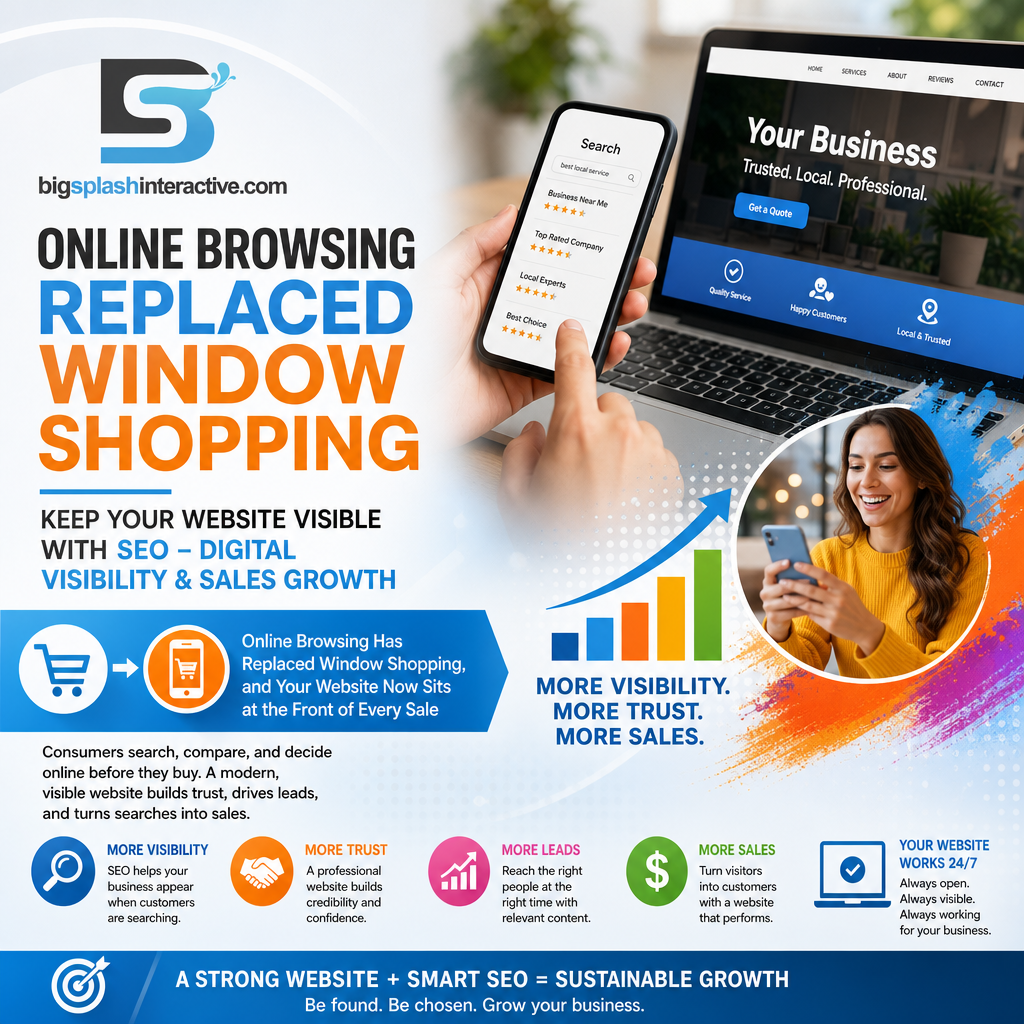
Consumers no longer stroll down the street to discover businesses first. They search, compare, scroll, and decide online. A modern, visible website is no longer optional for companies that want consistent leads, stronger trust, and steady revenue growth.
For generations, local businesses depended on foot traffic, storefront displays, signage, and word-of-mouth to bring in new customers. A well-dressed display window could catch attention, spark curiosity, and lead to a purchase. Today, that same process still happens, but it happens on screens. Instead of walking past a shop and looking into the window, people pull out a phone, open a browser, and begin searching. They compare products, read reviews, visit websites, and make decisions long before they ever call, visit, or buy.
This shift has completely changed the customer journey. Online browsing has replaced traditional window browsing in nearly every industry. Whether someone needs a restaurant, contractor, boutique, accountant, medical provider, or retail product, their first impression is usually digital. In many cases, your website becomes the first conversation your business has with a potential customer. If that website is outdated, hard to navigate, slow to load, or difficult to find, sales opportunities can disappear before they even begin.
Businesses that understand this shift put themselves in a stronger position to compete. They invest in websites that are current, clear, mobile-friendly, and designed to help visitors take the next step. They also recognize a second essential truth: having a website is only part of the equation. If potential customers cannot easily find it in search results, even a great site can remain invisible. That is where search engine optimization becomes a critical part of modern business growth.
In the past, location often determined visibility. A business on a busy corner had a natural advantage because people saw it every day. In the digital marketplace, visibility works differently. Your business may be excellent, your products may be better, and your service may be stronger than the competition, but if your website is buried beneath other listings, many buyers may never discover you.
Search engines now function as the modern main street. Customers browse results the same way they once browsed shopping districts. They notice businesses that appear prominently. They click on sites that look trustworthy. They form immediate opinions based on page design, messaging, reviews, and professionalism. In effect, your website and your search presence together have become your new storefront window.
This creates both an opportunity and a challenge. The opportunity is enormous because your business is no longer limited to the people walking by your physical location. You can attract prospects across your city, region, or even far beyond. The challenge is that every competitor is trying to capture that same attention. To succeed, your site must not only look professional but also stand out in search.
When someone lands on your website, they begin evaluating your business immediately. They may not consciously score every detail, but they are making quick judgments based on what they see and experience.
If the answer to these questions is unclear, hesitation sets in. Visitors may leave and continue comparing other businesses. In a digital environment, this happens in seconds. A neglected website can quietly cost a company leads every single day without any obvious warning sign beyond weaker conversion rates and missed inquiries.
By contrast, an up-to-date website supports sales in multiple ways. It communicates professionalism, reinforces trust, presents your value clearly, and gives visitors the confidence to move forward. It can answer common questions, highlight benefits, display social proof, and guide users toward booking, calling, requesting a quote, or making a purchase. In this sense, your website is not just an online brochure. It is a sales tool working around the clock.
Many business owners know they need a website, but some continue operating with sites that no longer reflect the quality of their business. Maybe the design feels old, the content is sparse, the images are dated, or the site performs poorly on mobile devices. In some cases, contact details are no longer accurate, service pages are incomplete, or key updates have not been made in years.
These issues may seem minor internally, especially when the business itself is strong. But from a customer perspective, they can signal neglect or inconsistency. If a company does not appear current online, some visitors may question whether the service is current as well. This is especially true in competitive markets where customers are reviewing several options at once.
An up-to-date website does more than improve aesthetics. It keeps your brand aligned with present-day expectations. Today’s users expect fast load times, easy navigation, clear calls to action, and a smooth mobile experience. They also expect useful content that helps them make informed decisions. Meeting these expectations can directly influence inquiries, appointments, and purchases.
A great website is valuable only when people can find it. This is one of the biggest realities in digital marketing. Businesses sometimes invest in a redesigned site and assume that traffic will naturally follow. In practice, visibility must be actively built and supported. Search engine optimization, often referred to as SEO, helps position your website where prospective customers are already looking.
SEO is the process of improving your website so search engines can better understand it, trust it, and present it to users searching for relevant products or services. It helps connect your business with people who already have intent. These are not random viewers with little interest. They are users actively searching for solutions, information, providers, or products connected to what you offer. That makes search traffic especially valuable from a sales perspective.
When your site appears in stronger positions for relevant searches, you gain more than clicks. You gain visibility at the exact moment customers are evaluating options. This can increase traffic, improve lead quality, and strengthen your authority in the market. For many businesses, SEO is one of the most effective long-term strategies for creating sustainable online growth.
One of the strongest advantages of search engine optimization is timing. It puts your business in front of people during active research and purchase consideration. Traditional advertising can create awareness, but search traffic often captures demand that already exists. Someone searching for a service in your area or researching a product category is already moving through the buying journey. A well-optimized website can meet them in that moment with relevance and clarity.
This matters because timing and intent strongly influence conversion rates. Visitors who find your business through relevant search terms are frequently more prepared to act than cold audiences. They may be looking for pricing, service details, business hours, availability, or a provider they can trust. If your website delivers the information they need in a polished and persuasive way, the path to conversion becomes much shorter.
SEO also supports credibility. Businesses that rank well are often perceived as more established and reliable, even before a visitor clicks. Prominent visibility sends a signal that your company is active, relevant, and worthy of attention. While rankings alone do not close sales, they can open the door to far more opportunities.
The buyer journey is now shaped by independent research. Customers want to feel informed before they contact a business. They look through service pages, compare offerings, review testimonials, and search for answers to common questions. In other words, they are browsing online in the same exploratory way people once browsed physical displays.
This behavior reinforces the importance of keeping your website updated and informative. If a visitor finds shallow content, unclear service descriptions, or missing information, they may move on to a competitor that provides a more complete experience. On the other hand, if your website anticipates customer needs and addresses them clearly, it can shorten the decision-making process and create more confidence in your brand.
Search engine optimization supports this process by helping your content show up for those early-stage and mid-stage searches. It is not only about ranking for the most obvious terms. It is also about aligning pages with real customer questions, service needs, and local buying behavior. This allows your business to appear throughout more stages of the decision process, not just at the final moment.
A high-performing website should do more than exist. It should actively support revenue by performing key sales tasks every day and every night.
When paired with SEO, this sales function becomes even more powerful. Instead of waiting for visitors to arrive by chance, your site is better positioned to attract them through relevant search activity. That combination of discoverability and conversion strength is what turns a website into a practical business asset rather than a static online presence.
For local businesses in particular, the move from window browsing to online browsing has changed the battlefield. It is no longer enough to be known in the neighborhood or located in a convenient area. Many customers now search online even when they fully intend to buy locally. They want to compare options before they leave home, and they often make choices based on the quality and visibility of a company’s online presence.
This means a smaller business can compete effectively if its website is strong and optimized well. It also means a long-established business can lose attention if its digital presence is weak. Search engine optimization helps level that playing field by giving local companies a way to appear in front of nearby customers at the exact moment they are ready to engage.
Strong local visibility can influence phone calls, quote requests, appointments, directions, and in-store visits. When consumers find trustworthy information quickly, they are more likely to choose a business with confidence. That makes website quality and SEO especially important for service-based companies, retailers, healthcare providers, home improvement businesses, and any organization that relies on local demand.
Digital visibility is not a one-time project. Customer expectations evolve, search behavior changes, and competitors continue improving their online presence. Businesses that treat their website as a living part of the sales process are better positioned to adapt. Regular updates, fresh content, technical improvements, and ongoing search optimization all help maintain momentum.
This creates long-term value in several ways. First, it strengthens the consistency of lead generation by increasing the chances that new prospects will find you. Second, it improves efficiency because your website can answer questions and pre-qualify leads before your team gets involved. Third, it supports brand equity by presenting a polished and professional image across the buyer journey.
SEO contributes to this long-term value by building durable visibility. Paid advertising can be effective, but it often stops producing the moment spending stops. Organic search visibility, when earned and maintained properly, can continue generating traffic and leads over time. For many businesses, this makes SEO an important investment in sustainable growth rather than a short-term tactic.
Online browsing has fundamentally changed the way people discover, evaluate, and choose businesses. The digital experience now shapes the customer’s first impression, builds trust, and often determines whether they move forward at all. In that environment, an up-to-date and highly visible website is essential. It is the digital equivalent of having the best storefront on the busiest street, open all day, every day.
But visibility does not happen automatically. Search engine optimization helps your website earn placement where your audience is already looking. It strengthens your ability to reach relevant prospects, compete for attention, and turn search activity into real business opportunities. When your website is modern, persuasive, and supported by SEO, it becomes far more than an online necessity. It becomes a direct contributor to sales performance.
As consumer habits continue shifting toward digital discovery, businesses that invest in website quality and search visibility place themselves in a much stronger position for future growth. The companies that understand this are not simply keeping up with the market. They are meeting customers where buying decisions now begin.
People used to browse storefront windows to decide where to shop. Now they browse search results and websites. If your business wants more opportunities to earn trust, generate leads, and increase sales, your website must be current, easy to use, and highly visible. Search engine optimization helps put that website in front of the right audience, turning online browsing into measurable business growth.