

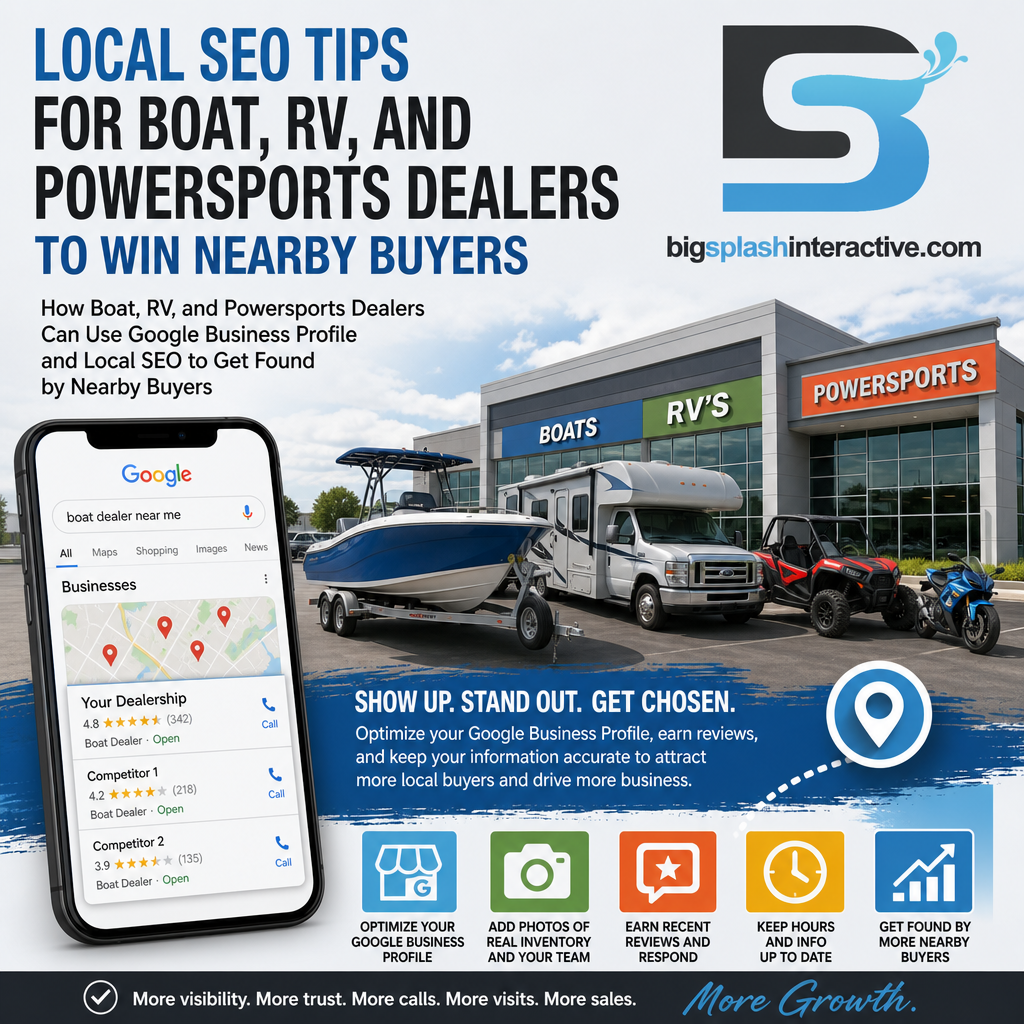
If your dealership depends on customers who are willing to drive to your showroom, service lane, or lot, your visibility in local search matters as much as your inventory. When buyers search for a boat dealer near me, RV dealer in [city], or powersports dealer open now, Google usually shows a map and a short list of businesses before it shows regular website results. That local visibility can drive more phone calls, more direction requests, more website visits, and more foot traffic from shoppers who are already close to making a purchase.
For dealership owners and marketing managers, the good news is this: improving your local presence does not require deep technical knowledge. The biggest gains usually come from getting the basics right and keeping them current. Your Google Business Profile, your reviews, your photos, your hours, and the consistency of your dealership information across the web all influence whether you appear when local buyers are searching.
This guide explains what to do, why it matters, and which mistakes most dealers make when trying to improve local visibility for marine, RV, and powersports sales and service.
Most buyers in these industries do not purchase on impulse, but they do use search to narrow options quickly. They compare inventory, check reviews, verify hours, look at photos, and decide which dealership feels worth the drive. Even if your market area covers multiple towns or counties, most of your strongest prospects are still searching within a practical driving distance.
That is why local SEO is so important. It helps Google understand three things about your dealership:
When those signals are clear and consistent, your dealership is more likely to appear in the local pack, which is the map-based set of business listings that often appears at the top of local searches. Appearing there can make a major difference because buyers often click from the map results before they ever scroll to organic website listings.
Your Google Business Profile is the listing that appears in Google Maps and in the business panel on Google Search. For many potential customers, it is the first impression of your dealership. In some cases, it is the only thing they look at before calling or visiting.
A well-managed profile helps your dealership show up for local searches related to:
It also gives searchers fast access to the information they care about most: your address, phone number, hours, reviews, photos, directions, and website.
One of the biggest mistakes dealerships make is setting up a profile and only completing the bare minimum. A half-finished profile gives Google less confidence and gives buyers less reason to contact you. The more complete and accurate your profile is, the better your chances of being shown for relevant local searches.
Use your real dealership name exactly as it appears in the real world. Do not stuff it with extra keywords such as city names, product types, or slogans unless those are truly part of your legal or public-facing business name. Adding phrases like “Best RV Dealer in Central Florida” to the business name can create compliance issues and confusion.
Your primary category is one of the strongest signals you can give Google. Choose the category that best matches your main business activity. For example:
Then add secondary categories where they fit your operation, such as repair shop, parts store, trailer dealer, marine supply store, or ATV dealer. Categories help Google match your dealership to different types of searches, so choose carefully and only use categories that truly apply.
Your physical address should be complete and accurate. This is essential for map visibility and route guidance. If customers come to your location, your address must be correct down to suite numbers, directional details, and road formatting. Even small differences between your profile and your website or directories can weaken trust signals.
Use a local, direct number whenever possible. Make sure the same main number appears consistently on your website and across major directory listings. If different platforms show different numbers, Google may have trouble confirming your business details.
Add your main website URL and make sure it leads users to the correct location or dealership page. If you have multiple rooftops, each profile should point to the corresponding location page rather than a generic homepage whenever possible.
List your regular sales hours accurately and update holiday hours ahead of time. If your service department runs on different hours, that should be reflected as well if available within your listing setup. Accurate hours affect customer trust, and they can also influence visibility for searches like open now.
If your dealership offers delivery, pickup, mobile repair, or service beyond the showroom location, your service area settings help communicate that. These are especially useful when customers search from nearby towns. However, service areas do not replace the importance of having a real location. They support your visibility across a region but do not turn your listing into a statewide ranking machine.
Write a clear, readable description of what your dealership sells, what brands you carry, what services you offer, and which local markets you serve. This is not a place for keyword stuffing. Instead, focus on explaining your value in plain language. Mention boats, RVs, motorcycles, ATVs, service, financing, trade-ins, parts, and your customer area where relevant.
Use the products and services sections to reinforce what you offer. Include categories such as new boats, used RVs, side-by-sides, personal watercraft, outboard service, winterization, trailer repair, oil changes, accessory installation, and financing support if applicable. These fields help fill in the context Google uses to understand your dealership.
Attributes can include practical customer details such as wheelchair accessibility, in-store shopping, delivery, veteran-led ownership, payment types, or appointment availability. Fill these in accurately. They may not be the biggest ranking factor, but they help buyers decide whether your dealership fits their needs.
This is one of the most underused parts of a dealership profile. Add recent, real photos of your exterior, showroom, lot, service bays, parts department, staff, and actual inventory. More on this below, because photos often affect both rankings and customer response.
Monitor the Q&A area regularly. If buyers ask whether you carry a certain brand, offer financing, take trades, or service a specific unit, respond clearly and quickly. This section can become a quiet conversion tool if managed well.
Many dealerships upload a logo, a building photo, and then stop. That is a missed opportunity. Google wants to recommend businesses that look active, legitimate, and useful to searchers. Buyers want proof that your dealership is real, current, and worth visiting. Fresh photos support both goals.
For boat, RV, and powersports dealers, photos do several important jobs at once:
Google does not publish a formula that says “upload this many photos and rank higher,” but in practice, complete and active profiles tend to perform better. That is because Google is looking for evidence that your dealership is a good local result. A profile full of current, authentic photos supports that case.
The key is authenticity. Use real photos from your dealership, not generic manufacturer-only visuals and not outdated images from years ago.
Reviews matter for two separate reasons. First, they influence customer decisions directly. Second, they send relevance, trust, and activity signals to Google. A dealership with strong, recent reviews often has a better chance of standing out in local results than one with old, sparse, or unaddressed feedback.
Google pays attention to review signals such as:
When customers leave detailed reviews mentioning experiences like boat delivery, RV trade-ins, ATV service work, financing help, or parts support, those reviews can reinforce what your dealership is known for. That can improve relevance for related local searches.
A dealership with 300 reviews from several years ago but almost no recent activity can look stale. Google wants to show businesses that are active now. Buyers think the same way. If your newest review is eight months old, shoppers may wonder whether management still cares about the customer experience.
That is why asking for reviews consistently is more effective than asking in bursts. Build review generation into your sales and service process. A steady flow of genuine customer feedback is better than occasional campaigns that create spikes and then go silent.
Responses show customers and Google that your dealership is paying attention. Thank customers for positive reviews and address concerns professionally when reviews are negative. Do not argue. Do not get defensive. A calm, helpful response can protect your reputation and show prospects that you take service seriously.
Hours and service areas may seem like minor settings, but they can have a direct impact on search performance and customer behavior.
When buyers search after work, on weekends, or during travel, they often include terms like open now or choose businesses that Google indicates are currently open. If your hours are inaccurate, missing, or outdated, you may lose visibility and buyer confidence.
This matters even more for dealerships because operating hours can differ by department. If your sales floor is open but service is closed, or your weekday and Saturday hours are different, your listing should reflect that as closely as possible. Correct hours reduce frustration and help prevent negative reviews from customers who arrive when they expected you to be open.
Many profiles go months without updates, then a holiday arrives and customers show up to a locked door. Google often prompts businesses to confirm special hours for holidays. Do it. This small task protects your reputation and shows Google your profile is being actively managed.
If you serve customers across several cities, counties, lakes, campgrounds, or trail regions, service areas help tell Google that your reach extends beyond your street address. This can support visibility in nearby communities where you already do business.
However, it is important to set expectations correctly. Service area settings do not mean you will rank equally well in every town within a hundred miles. Google still heavily weighs proximity. Your physical location remains one of the strongest local ranking factors. Service areas help clarify your market, but they are not a shortcut around distance.
Many local SEO problems are not caused by complicated technical issues. They come from neglect, inconsistency, or confusion across multiple systems. Here are the mistakes that most often hold dealers back.
Duplicate listings are a common problem, especially for dealerships that have changed names, moved locations, acquired another store, or have separate departments that were listed independently. Duplicates can split reviews, confuse Google, and weaken your local authority.
If Google sees two profiles for what looks like the same business, it may not know which one to trust. Customers may also call the wrong number, visit the wrong listing, or leave reviews on the wrong profile. Cleaning up duplicates should be a priority.
Your dealership’s name, address, and phone number should be consistent wherever they appear online. That includes major directories, map platforms, your website, social profiles, local chamber listings, and industry citations.
Inconsistency might look small to a human, but it can create trust problems for search engines. For example:
When Google finds conflicting information, your profile may lose some credibility. Consistency helps reinforce that your dealership is exactly who it says it is and exactly where it says it is.
A stale profile can hurt both rankings and conversions. If your inventory photos are old, your hours are wrong, your last review response was months ago, and your description still mentions brands you no longer carry, buyers notice. Google notices active management too.
Local SEO is not a one-time setup. It is ongoing maintenance. The dealership that keeps its profile current often outperforms a competitor with a stronger brand but a neglected local presence.
If your main category is too broad or inaccurate, Google may show your profile for the wrong searches or fail to show it for the right ones. A boat dealership should not use a vague category if a more precise option is available. The same applies to RV and powersports stores. Category accuracy helps your profile show up in front of the right shoppers.
Some dealers only pay attention to reviews when there is a problem. That leaves positive reputation building on the table. Reviews should be a regular operating process, not a damage-control activity. Consistent review requests and consistent responses support better visibility and higher buyer confidence.
Stock imagery does not build the same trust as real photos of your showroom, staff, and units. If your listing looks generic, buyers may assume the experience will be generic too. Real visuals help your dealership stand out in a crowded local market.
If you have multiple rooftops, each Google Business Profile should align with its own website location page whenever possible. That page should show the matching address, phone number, hours, inventory focus, and local details. This helps Google connect the listing to the right dealership location.
Many dealerships focus local SEO only on vehicle sales. That is a mistake. Service, parts, repairs, winterization, and maintenance searches are also highly local and often convert very well. Buyers looking for service are usually ready to act. Make sure your profile and website clearly reflect those offerings.
Although Google Business Profile is central to local visibility, your website still plays a major supporting role. Google compares what it sees on your profile with what it sees on your site. If both tell the same clear story, your local presence becomes stronger.
Your dealership website should have a page dedicated to each physical location. That page should include:
This helps both customers and search engines confirm your local identity.
You do not need to overdo city names, but you should clearly mention the communities you serve. If you are the nearest marine dealer to a popular lake region, or a major RV dealer serving multiple nearby counties, say so naturally on the relevant pages. This helps support regional relevance.
If your service department is a major part of the business, give it dedicated space on the site. A service page for boats, RVs, or powersports equipment can help you show up for maintenance and repair searches within your area.
If you want local SEO to stay manageable, treat it as a repeating process instead of a special project. A simple monthly routine can keep your profile healthy and competitive.
It is easy to think of local SEO as a marketing task that only affects search visibility. In reality, it influences real dealership outcomes. A better-managed Google Business Profile can lead to:
For high-consideration purchases like boats, RVs, and powersports units, buyers often compare several dealers before deciding where to go. If your profile is more complete, more current, and more trustworthy than your competitors, you improve your odds of being the dealership they visit first.
If you are not technical, start with the actions that have the most immediate impact:
You do not need to master every detail of search engine optimization to improve local visibility. Most dealerships can make meaningful progress simply by being accurate, consistent, and active.
When buyers are searching within driving distance of your showroom, Google Business Profile and local SEO are not optional. They are part of how your dealership gets discovered, evaluated, and chosen. A complete profile, real photos, steady reviews, accurate hours, and consistent dealership information across the web all work together to improve your chances of appearing in the local pack and winning more nearby business.
For boat, RV, and powersports dealers, the opportunity is straightforward: show Google that your dealership is real, relevant, and active, and show buyers that you are worth the drive.