

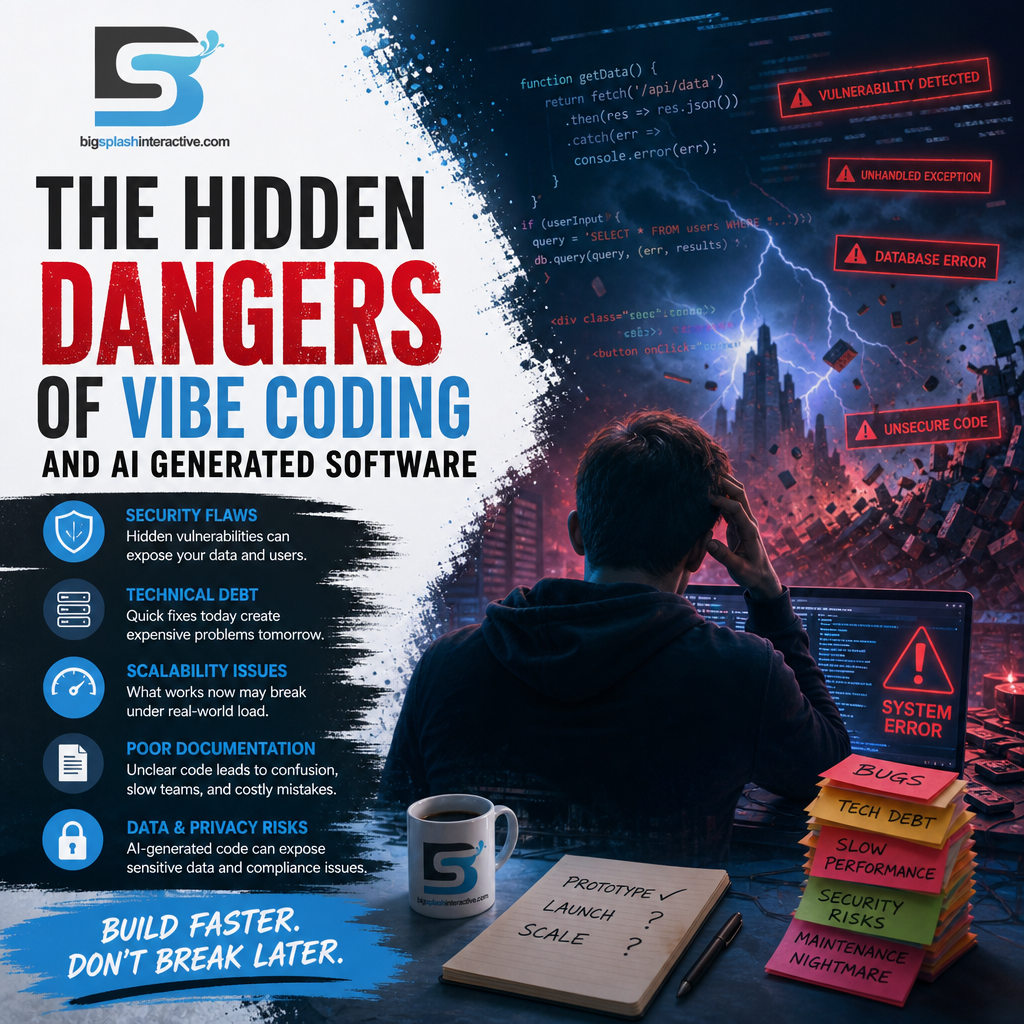
AI has changed software development faster than almost any other shift I have seen in decades of building websites, applications, digital platforms, and business systems. Tasks that once took days can now take hours. Prototype interfaces can appear in minutes. Entire scripts, integrations, and even full-stack applications can be generated from a few prompts.
That speed is impressive. It is also dangerous when speed creates the illusion of understanding.
A growing number of founders, marketers, junior developers, and even established companies are leaning into what many now call vibe coding: building software by prompting AI tools until something appears to work, without fully understanding how the underlying code, architecture, security model, or infrastructure actually functions.
This is not an argument against AI. Quite the opposite. AI is one of the most powerful development tools ever introduced. Used correctly, it can accelerate delivery, improve productivity, reduce repetitive work, and help skilled teams move faster. Used carelessly, it can create fragile systems, hidden security issues, expensive technical debt, and business technology risks that do not become visible until the application is already live and critical to operations.
If you are a business owner considering AI-powered development, an entrepreneur building a startup, a non-technical founder launching your first product, or a developer trying to work responsibly in this new era, this is the real conversation worth having: AI can help you build faster, but blindly trusting generated code can leave you with slow, expensive problems later.
Vibe coding is a modern shorthand for a style of software creation where the developer, founder, or creator relies heavily on AI to generate code, fix bugs, connect systems, and shape applications based more on intuition and output than on actual technical understanding.
In vibe coding, the workflow often looks like this:
The defining issue is not using AI. Professional developers do that every day. The issue is using AI as a substitute for understanding rather than as a tool to support expertise.
This approach has become popular because modern AI software development tools are shockingly capable. They can scaffold apps, generate APIs, write SQL queries, create landing pages, suggest infrastructure configurations, and translate one language or framework into another. For someone with an idea but limited technical background, that feels revolutionary.
And in some ways, it is. But revolutions always come with side effects.
The emergence of AI coding assistants has fundamentally changed the development process. For years, programmers relied on documentation, forums, internal knowledge bases, and long debugging sessions to solve problems. Now, an AI can propose a solution instantly, often with clean syntax and persuasive confidence.
That changes behavior in several important ways:
Those are real benefits. I have seen experienced teams save enormous amounts of time by using AI to generate repetitive functions, accelerate interface development, summarize documentation, identify patterns in legacy code, and create first drafts of technical implementations.
But AI did something else too: it made code generation easy enough that many people now mistake generated output for software engineering.
One of the most exciting aspects of AI-assisted development is accessibility. Someone with a business concept can now create a functional app demo without hiring a full team on day one. A founder can test an idea before seeking investment. A business owner can automate a repetitive process without waiting months for a custom build.
In the past, getting from concept to prototype often required substantial budget, technical planning, and development time. Today, AI can collapse that cycle dramatically. This gives startups and small businesses a meaningful advantage, especially when speed to market matters.
For non-technical founders, AI removes much of the intimidation traditionally associated with software creation. You no longer need to understand every framework, syntax rule, or infrastructure requirement to get started. That democratization is valuable.
There is also a psychological factor that should not be underestimated. Seeing an idea become real on a screen in minutes creates momentum. It builds confidence. It makes the future feel tangible. For founders and entrepreneurs, that can be deeply motivating.
The problem is that early success often hides structural weakness. What feels magical at the prototype stage can become expensive at the production stage.
This is where the real risks begin. AI-generated code often looks polished. It may even run correctly in limited testing. But software quality is not measured by whether a feature appears to work once. It is measured by how reliably, securely, maintainably, and efficiently that system performs over time.
One of the biggest AI generated code risks is security. AI tools can produce authentication logic, form processing, database queries, and API integrations that seem correct but include serious flaws. These may include weak input validation, insecure token handling, poor session management, exposed credentials, and vulnerable dependency usage.
A business owner may not notice these problems until customer data is exposed, an admin panel is compromised, or a compliance review fails. In my experience, security issues are especially dangerous because they often stay invisible until they become public.
AI can generate code for the problem you ask about, but it does not automatically design a healthy long-term system. Applications built through disconnected prompts often end up with inconsistent patterns, duplicated logic, weak separation of concerns, and architecture that does not reflect actual business goals.
The result is software that grows awkwardly. Every new feature becomes harder to add. Performance suffers. Maintenance costs rise. Refactoring becomes unavoidable.
A prototype that works for ten users may fail badly at one thousand. AI-generated solutions often optimize for immediate functionality rather than scalability. Database queries may be inefficient. File handling may be careless. State management may be unstable. Server load assumptions may be unrealistic.
This is a classic pattern in startup environments: the demo impresses everyone, then real customer usage exposes slow response times, crashes, and unreliable workflows.
Technical debt is what happens when short-term implementation decisions create long-term cost. Vibe coding can accelerate technical debt dramatically because each prompt-based fix may patch a symptom without addressing the underlying design issue.
Over time, businesses end up with tangled codebases full of inconsistencies. Things stop being easy to change. Even small updates become risky. What looked cheap at launch becomes expensive in maintenance, troubleshooting, and redevelopment.
AI tools frequently recommend libraries, frameworks, plugins, or packages without fully considering long-term viability. Some dependencies may be outdated, poorly maintained, unnecessarily complex, or incompatible with future platform updates.
If your app depends on a fragile stack selected by convenience rather than strategic evaluation, you may inherit major upgrade problems later.
Many vibe-coded projects suffer from poor documentation because the creator never fully understood the implementation in the first place. If there is no clear explanation of architecture, business rules, integrations, deployment setup, or security assumptions, future developers must reverse engineer everything.
That increases onboarding time, support costs, and the likelihood of making things worse while trying to fix them.
When the original creator does not understand the code, debugging becomes guesswork. Instead of diagnosing root causes, they ask the AI for another patch. That often introduces new problems or layers additional complexity on top of the existing issue.
I have seen projects where each AI-generated fix created two more edge cases. The app kept appearing functional until real users exposed the cumulative instability.
Businesses also need to think carefully about data governance. AI-assisted workflows can create privacy concerns in two ways: first, through insecure application code; second, through the prompts and datasets shared with development tools during the coding process.
If sensitive customer data, internal logic, or proprietary workflows are exposed carelessly, the damage can extend beyond software bugs into legal, reputational, and regulatory territory.
One of the oldest problems in software development is the illusion that local success equals production readiness. Vibe coding intensifies this problem.
AI-generated code often solves the immediate issue in the narrow environment where it was tested. The page loads. The script runs. The form submits. The dashboard renders. On the surface, that looks like success.
But software does not live on one machine under ideal conditions. It lives across browsers, devices, user permissions, hosting environments, traffic spikes, edge cases, third-party integrations, compliance requirements, and future updates.
That is why so many AI coding mistakes are not obvious at launch. The problem is rarely that the code does nothing. The problem is that it does one thing successfully while quietly creating five future problems:
For businesses, the risks of vibe coding are not just technical. They are operational, financial, strategic, and legal.
When AI-generated code powers customer portals, booking systems, internal dashboards, ecommerce processes, CRMs, or data workflows, the cost of failure rises dramatically. Critical systems require experienced oversight because the consequences of weak decisions are rarely immediate. They emerge later as downtime, security incidents, workflow failures, or customer dissatisfaction.
Some AI-built systems rely heavily on proprietary platforms, rigid no-code layers, or tool-specific patterns that make migration difficult. What starts as convenience can become lock-in. If your business cannot move, modify, or independently maintain its own systems, you are more vulnerable than you may realize.
Business owners should always understand how their application is built, what third-party components it depends on, and who controls the deployment environment, code repositories, and supporting services. If all of that lives inside opaque AI workflows or outsourced prompt-based development without process discipline, control over your intellectual property can become blurred.
Cheap builds can be expensive to keep alive. When software lacks structure, documentation, and consistent quality, future developers need more time to understand it before they can safely improve it. Maintenance becomes slower. Feature development costs increase. Emergency fixes become common.
If your business handles customer information, payments, healthcare data, contracts, internal records, or regulated workflows, AI-generated code should never go live without proper review. Security and compliance are not areas for guesswork. They require deliberate process, auditing, testing, and accountability.
This distinction matters.
AI-assisted development means using AI as a productivity tool within a disciplined engineering process. Vibe coding means using AI as a replacement for that process.
| AI-Assisted Development | Vibe Coding |
|---|---|
| Code is reviewed by someone who understands it | Code is trusted because it appears to work |
| Architecture is planned deliberately | Architecture emerges randomly from prompts |
| Testing is systematic | Testing is informal and limited |
| Security is evaluated proactively | Security is assumed unless a problem appears |
| Documentation is maintained | Knowledge stays trapped in prompt history |
| AI accelerates expertise | AI replaces understanding |
That is the core issue. The problem is not using AI. The problem is surrendering judgment to it.
Experienced developers are not ignoring AI. They are using it aggressively, but responsibly. In strong engineering environments, AI is treated like a very fast assistant, not an unquestioned authority.
Professionals read what AI produces. They evaluate whether it is efficient, secure, readable, and aligned with project standards. They do not paste blindly into production.
Strong developers think beyond the function level. They consider system design, maintainability, scaling patterns, deployment needs, database structures, service boundaries, and long-term business requirements before deciding whether generated code belongs in the project.
AI-generated code still needs unit tests, integration tests, browser testing, device testing, failure testing, and performance validation. Real quality comes from verification, not from confidence in the prompt.
Professional teams review authentication, authorization, validation, secrets management, API exposure, logging practices, and third-party dependencies. They know that secure-looking code is not always secure code.
Often, AI gives a good first draft but not the best final implementation. Skilled developers refactor generated output so it fits the project cleanly, follows conventions, reduces repetition, and remains understandable for future maintenance.
This is the healthiest model for AI software development. AI handles repetitive work, offers alternatives, speeds up research, and shortens implementation cycles. Human expertise provides judgment, architectural thinking, quality control, and accountability.
The future of programming will not belong exclusively to people who type code fastest. It will belong to people who can design systems wisely, review generated output critically, and align technology with real business goals.
As AI handles more implementation work, developers will spend more time defining structure, evaluating tradeoffs, verifying quality, and protecting long-term maintainability. The craft will shift upward from syntax production toward systems thinking.
Non-technical founders and business leaders do not need to become software engineers, but they do need enough AI literacy to ask better questions. Who reviewed this code? How is security handled? What happens when we scale? Who owns the repositories and infrastructure? How hard will this be to maintain in two years?
When code generation becomes abundant, the competitive advantage shifts. It is no longer about who can produce more code. It is about who can produce better outcomes. That means stronger review, clearer architecture, better testing, more thoughtful UX, tighter security, and lower long-term business technology risks.
In other words, the future is not less professional discipline. It is more.
If you are considering AI-powered development for your company or startup, the answer is not to avoid it. The answer is to use it with structure.
That approach allows you to benefit from AI without letting convenience quietly undermine your business.
Vibe coding is the practice of using AI tools to generate software, websites, scripts, or applications based largely on prompts and trial-and-error, without fully understanding the underlying code or architecture.
No. It can be useful for quick prototyping, idea validation, and experimentation. The danger comes when businesses rely on it for production systems without review, testing, security analysis, or experienced oversight.
The biggest risks include security vulnerabilities, poor scalability, technical debt, undocumented systems, dependency problems, privacy exposure, and difficulty maintaining software that the original creator does not understand.
Businesses should use AI to accelerate development, not replace professional judgment. That means code review, testing, architectural planning, security auditing, documentation, and maintaining ownership over the codebase and infrastructure.
AI-assisted development uses AI as a tool within a disciplined engineering process. Vibe coding uses AI as a substitute for technical understanding and structured development practices.
AI will change development significantly, but it is more likely to elevate the importance of developers who can design systems, review code, ensure quality, and manage risk. The future of programming will reward judgment as much as implementation skill.
For a digital marketing or web development company, this article can naturally support internal links to service and educational pages such as:
Vibe coding exists because AI is powerful. It lowers barriers, unlocks creativity, accelerates prototyping, and helps more people participate in software creation than ever before. That is the good news.
The hard truth is that software does not become reliable, secure, scalable, or maintainable just because it was generated quickly. In fact, speed often hides the very problems that become most expensive later.
Businesses should not fear AI. They should fear unreviewed systems, unmanaged complexity, and false confidence. Founders should absolutely use AI to move faster, but they should also know when to bring in real technical oversight. Developers should embrace AI, but not surrender engineering discipline to it.
AI can help you build faster, but understanding what you build is what keeps your business from breaking later.