

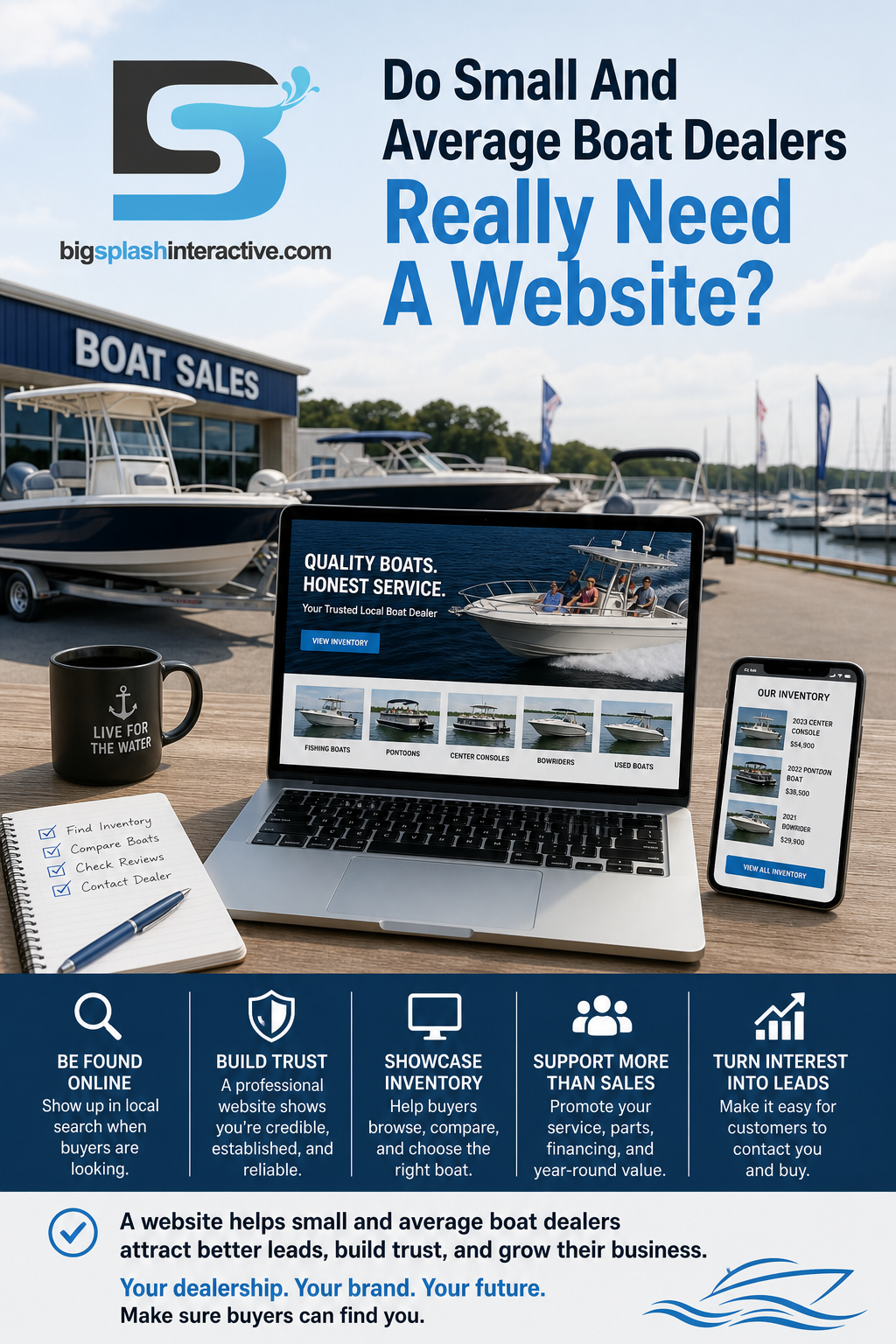
For many independent marine retailers, the question is no longer whether the internet matters, but whether a dedicated website is truly necessary. Small and average boat dealers often rely on foot traffic, marina relationships, repeat buyers, and marketplace listings to generate business. While those channels still matter, a professional website has become one of the most practical tools for improving visibility, building trust, and turning interest into sales.
In today’s market, buyers research boats long before they visit a dealership. They compare models, read specifications, review financing options, and look for signs that a dealer is credible and established. If your business does not have a website, many potential customers may never take the next step. They may assume you are too small, too difficult to reach, or not current with the market. Even when they hear about your dealership through referrals, social media, or online directories, they often still want to visit your website before they contact you.
The short answer is yes: small and average boat dealers do need a website. Not because every dealership needs a massive digital platform, but because even a simple, well-structured site can support sales, improve customer confidence, and help your inventory get discovered more easily.
Boat purchases are significant decisions. Whether someone is shopping for a fishing boat, pontoon, center console, bowrider, or used family cruiser, they usually spend time researching before reaching out. This is especially true for buyers comparing local dealerships. A website provides a central place where shoppers can evaluate your business on their own schedule.
Unlike third-party listing sites or social media pages, your website is your own digital storefront. It gives you full control over how your dealership is presented, how inventory is organized, and how potential buyers contact you. It can also answer common questions before a customer ever picks up the phone.
For boat dealers operating in competitive regional markets, that control is valuable. Buyers want clear information, up-to-date listings, and reassurance that they are dealing with a legitimate business. A website helps provide all three.
Consumer behavior has changed across nearly every retail sector, and the marine industry is no exception. Even if your buyers ultimately prefer to inspect boats in person, they usually begin online. They may search for boat dealers near them, browse inventory after business hours, or check whether you carry specific brands or boat types.
If your business only appears through a social media page or a basic directory listing, you may lose credibility with shoppers who want more detail. Social platforms are useful, but they are not a substitute for a website. Social media is often where people discover you; your website is where they confirm you are worth contacting.
A dedicated website also lets customers find practical information quickly, including:
When people can find answers easily, they are more likely to contact your dealership and move forward in the buying process.
Trust is a major factor in boat sales. Buyers are often making a substantial investment, and they want confidence in both the product and the seller. A polished website signals that your dealership is established, organized, and serious about serving customers.
This is especially important for smaller dealers that may not have the same name recognition as larger marine groups. A website helps level the playing field by giving your business a professional presentation. It allows you to showcase your team, your experience, your service approach, and the kinds of boats you specialize in.
Without a website, potential buyers may have unanswered questions:
A website gives you the opportunity to answer these concerns before a prospect chooses another dealership.
Many small boat dealers depend heavily on third-party marketplaces, classified sites, and dealer listing platforms. These can absolutely help generate exposure, especially for used inventory. However, relying on those channels alone comes with limitations.
On listing platforms, your dealership is presented alongside many competitors in nearly identical formats. Shoppers may compare pricing, but they do not get a full sense of your business, your reputation, or the value you provide. In many cases, the platform’s branding is stronger than yours.
A website gives you a place to bring those shoppers once they become interested. It allows you to expand on the listing with better photos, more detailed descriptions, dealership policies, service information, and a stronger local presence. It also reduces the risk of depending too much on platforms you do not control, where fees, policies, and visibility can change at any time.
One of the strongest reasons for a boat dealer to have a website is visibility in local search results. People often search using phrases tied to their area and purchase intent, such as used boat dealer nearby, pontoon boats for sale in a specific city, or outboard boat service near me. A website helps your dealership appear for those types of searches when the content is properly structured.
This matters because local search traffic is often high-intent traffic. These are not random browsers. They are people actively looking for a dealer, a type of boat, or a local service provider. If your site clearly presents inventory categories, service pages, location details, and relevant content, you have a much better chance of being discovered by the right audience.
For small and average boat dealers, showing up in local search can be one of the most cost-effective ways to compete with larger businesses.
Inventory is one of the biggest reasons to maintain a website. Boats are visual products, and buyers want details. They want to know the year, make, model, length, engine information, condition, price, included features, and whether the boat is still available. They also want to browse without pressure.
A good inventory page allows customers to filter and compare options more easily than they can on social posts or scattered classifieds. It also creates a better shopping experience by organizing listings in a way that reflects your dealership’s focus.
For example, your website can separate:
The easier it is for customers to browse inventory, the more likely they are to inquire about a specific boat.
Boat dealerships often offer more than inventory. Many provide service, winterization, storage, parts, electronics installation, trailer support, and engine maintenance. These revenue streams are important, especially during seasonal shifts or slower sales periods.
A website allows you to promote these offerings clearly. It can help your dealership attract year-round service inquiries, not just seasonal buyers. It can also educate customers about what you do beyond the sale, which can strengthen long-term retention.
This is one of the most overlooked advantages of a dealership website. Even when a visitor is not ready to purchase a boat today, they may still need service, accessories, trade-in support, or future assistance. A strong website keeps your business relevant at every stage of boat ownership.
Many smaller dealers generate business through word-of-mouth. Referrals are powerful, but even referred customers usually do online research before making contact. If someone recommends your dealership, the next step is often a search for your business name.
When that search leads to a clear, professional website, the referral becomes stronger. The customer can verify your location, view inventory, understand your specialties, and feel more comfortable reaching out. Without a website, the referral chain can weaken. A customer may hesitate if they find limited information or an outdated online presence.
In that sense, a website does not replace referrals. It supports them and helps them convert into real inquiries.
One common concern is that a website sounds expensive, complicated, or unnecessary for a modest-sized dealership. The good news is that a boat dealer does not need a massive custom platform to benefit from having a web presence. In many cases, a straightforward site with the right pages is enough to make a real impact.
A practical small dealership website may include:
The goal is not to create unnecessary complexity. The goal is to make it easy for buyers to find you, trust you, and contact you.
Branding may sound like something only larger dealerships worry about, but it matters for smaller operations too. Your reputation, your specialties, and the way you present your inventory all influence buying decisions. A website lets you shape that presentation intentionally.
If your dealership is known for honest used boat evaluations, family-friendly service, fishing expertise, or premium reconditioning, your site can communicate that clearly. It can also reinforce your local identity and highlight what makes your business different from national or multi-location competitors.
On third-party platforms, you rent attention. On your website, you own the experience.
Another advantage of having a website is the ability to publish useful content. Boat buyers often have questions about ownership, maintenance, financing, storage, and choosing the right type of vessel. Answering these questions on your site can improve search visibility and position your dealership as a helpful local resource.
Useful content ideas for boat dealers may include:
This type of content can attract search traffic from people who are not yet ready to buy but may become customers later. It also improves confidence among visitors who are already considering your dealership.
Not having a website does not mean a dealership cannot survive. Some businesses still do well through repeat buyers, marina relationships, local reputation, and offline sales channels. However, they often operate with avoidable limitations.
Without a website, a boat dealer may face:
In a market where buyers compare options carefully, those disadvantages can add up over time.
It is important to note that simply having a website is not enough if it is outdated or neglected. An old site with stale inventory, broken pages, or missing contact information can hurt more than help. For boat dealers, freshness matters because inventory changes often and seasonal promotions can shift quickly.
A useful dealership website should be maintained regularly. Inventory should be current, contact forms should work, and key business details should be accurate. Customers notice these things. A site that feels active and reliable makes a stronger impression and produces better results.
For smaller dealers, consistency usually beats complexity. A clean, updated site is far more effective than a large site that no one manages.
Yes, they do. A website is one of the most practical and valuable business tools a small or average boat dealership can have. It helps customers find you, trust you, browse your inventory, learn about your services, and reach out when they are ready.
That does not mean every dealer needs a large, expensive web build. It means every dealer should have a reliable online home base that supports local visibility, strengthens credibility, and gives potential buyers a better path to doing business with them.
In a competitive market where buyers research first and contact later, a website is no longer just a nice extra. For most boat dealers, it is a core part of staying visible, professional, and accessible.
If your dealership wants to attract better leads, present inventory more effectively, and reduce reliance on third-party platforms, having a website is not simply a digital upgrade. It is a smart business decision.
Small and average boat dealers may not need a complicated website, but they do need a credible, easy-to-use online presence. A professional website helps your dealership stand out, supports local search visibility, showcases your inventory, and turns interest into inquiries. In short, if you want buyers to take your business seriously and find you more easily, a website is no longer optional.